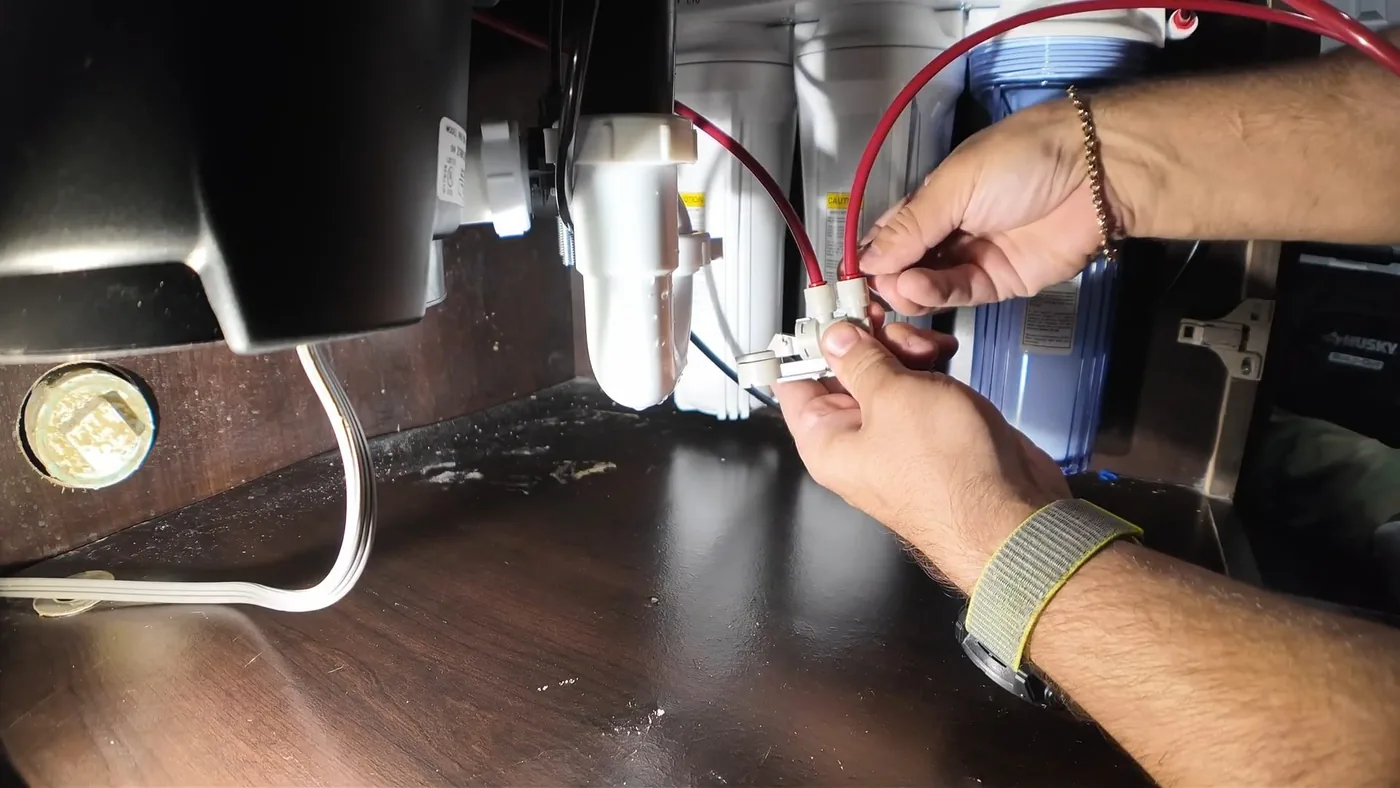
Buckeye's groundwater is some of the most mineral-rich in the Phoenix metro. Total dissolved solids (TDS) in City of Buckeye water can run 400 to 800 parts per million depending on the source well and season. A water softener removes the hardness minerals that cause scale, but it doesn't remove TDS, chloramines, nitrates, or other dissolved compounds. A reverse osmosis (RO) system at the kitchen sink handles what a softener doesn't, producing drinking water at 20 to 50 PPM TDS regardless of what comes out of the main supply line.
This guide covers what you'll pay for RO installation in Buckeye in 2026, what affects the cost, and whether pairing it with a water softener makes financial and practical sense.
What reverse osmosis installation costs in Buckeye (2026)
| Scenario | Typical Installed Cost | Notes |
|---|---|---|
| Standard 4-5 stage RO (under sink) | $350–$750 | Point-of-use at kitchen sink; includes dedicated RO faucet |
| RO with booster pump | $550–$950 | For homes with supply pressure below 40 PSI at kitchen cold supply |
| Refrigerator ice maker connection added | +$75–$175 | Add-on at same appointment; may require larger storage tank |
| Annual pre-filter replacement (sediment + carbon) | $150–$250 | Every 6 to 12 months in Buckeye's high-TDS groundwater |
| RO membrane replacement | $200–$350 | Every 2 to 3 years; extends to 3-4 years if home has softener |
What an RO system actually removes from Buckeye water
An under-sink RO system forces pressurized water through a semi-permeable membrane that blocks most dissolved solids and contaminants. For Buckeye water, the relevant removals are: calcium and magnesium (hardness minerals), total dissolved solids including desert aquifer minerals, chloramines used for disinfection by the City of Buckeye, nitrates from natural groundwater sources, and other trace constituents found in deep groundwater.
The result at the dedicated RO faucet is water at roughly 95 to 99 percent reduced TDS from the supply. At a supply TDS of 600 PPM, the output runs 20 to 50 PPM. Most people notice the difference in taste immediately. The flat, minerally character of Buckeye tap water disappears from drinking water and from coffee and ice made with RO water.
Does my Buckeye home need a booster pump?
RO membranes require a minimum of 40 PSI inlet pressure to operate efficiently. Most Buckeye homes have 50 to 80 PSI at the kitchen cold supply, which is within range. Homes with a pressure regulator set low, or homes where scale or partial-closure of shutoff valves has reduced pressure below 40 PSI at the RO inlet, need a booster pump. The booster pump adds $100 to $200 to the system cost plus installation labor.
A quick pressure check at the kitchen cold supply shutoff during the estimate visit confirms whether a booster pump is needed before any hardware is ordered.
How long do RO filters last in Buckeye's groundwater?
Buckeye's high TDS and hardness content shortens filter life compared to softer-water markets. Without a water softener upstream of the RO, the sediment pre-filter needs replacement every 3 to 6 months, and the carbon block stages need replacement every 6 to 12 months. The RO membrane itself lasts 2 to 3 years in Buckeye's groundwater without upstream softening.
For homes with a water softener in good working order, pre-filter life extends to 6 to 12 months, and the RO membrane can last 3 to 4 years. The softener removes the hardness minerals that otherwise foul the pre-filters and the membrane most aggressively. This is one of the practical arguments for installing the softener first, or at the same time as the RO, if both systems are planned.
RO vs. water softener: do Buckeye homes need both?
They address different problems and work best in combination. A water softener removes calcium and magnesium from the full household supply, protecting plumbing, water heaters, and appliances. An under-sink RO system removes a broader range of dissolved solids and contaminants from drinking water at the kitchen faucet. The softener doesn't improve drinking water taste because it replaces hardness ions with sodium ions rather than removing them entirely. The RO doesn't protect your plumbing because it only produces 1 to 4 gallons per hour, not enough to treat whole-house supply.
For Buckeye homes on City of Buckeye water: a water softener is the higher-priority investment for appliance and plumbing protection. An RO system is the higher-priority investment if your primary concern is drinking water quality and TDS reduction. Most Buckeye households who have both use the softener for all household water and the RO faucet exclusively for drinking water, cooking water, and the refrigerator ice maker.
Adding an RO system at the same appointment as a water softener installation typically saves one service call and reduces combined installation cost. If both systems are on your list, scheduling them together is the practical approach.
What is included in the installation cost
A standard RO installation includes: the 4-5 stage system with storage tank, mounting under the sink, connecting the saddle valve to the cold water supply, running the drain line for reject water, installing the dedicated RO faucet through the sink deck or a pre-drilled hole, flushing the new system to remove filter media residue, and testing output TDS with a digital meter to give you a baseline reading. The initial TDS measurement is documented so you have a comparison point for future filter change decisions.
Reverse osmosis installation in Buckeye and the West Valley
Systems sized for Buckeye's groundwater. Ice maker connections available. Annual filter replacement service offered. Serving Buckeye, Verrado, Goodyear, Avondale, and the West Valley.
✆ Call (623) 284-0371or request a free estimate online
Related: Reverse osmosis installation in Buckeye · Water softener vs. reverse osmosis: what Buckeye homes actually need · Why Buckeye relies on groundwater